

History Important dates | Politics | Navy | Love | Wars | Religion | Scuole | Ghetto | Printing
Aldo Manuzio, printing in Venice: the beginnings of an industry
The Italian Wars of the 16th century disrupted the printing industry... except in Venice, where political neutrality enabled it to continue its development.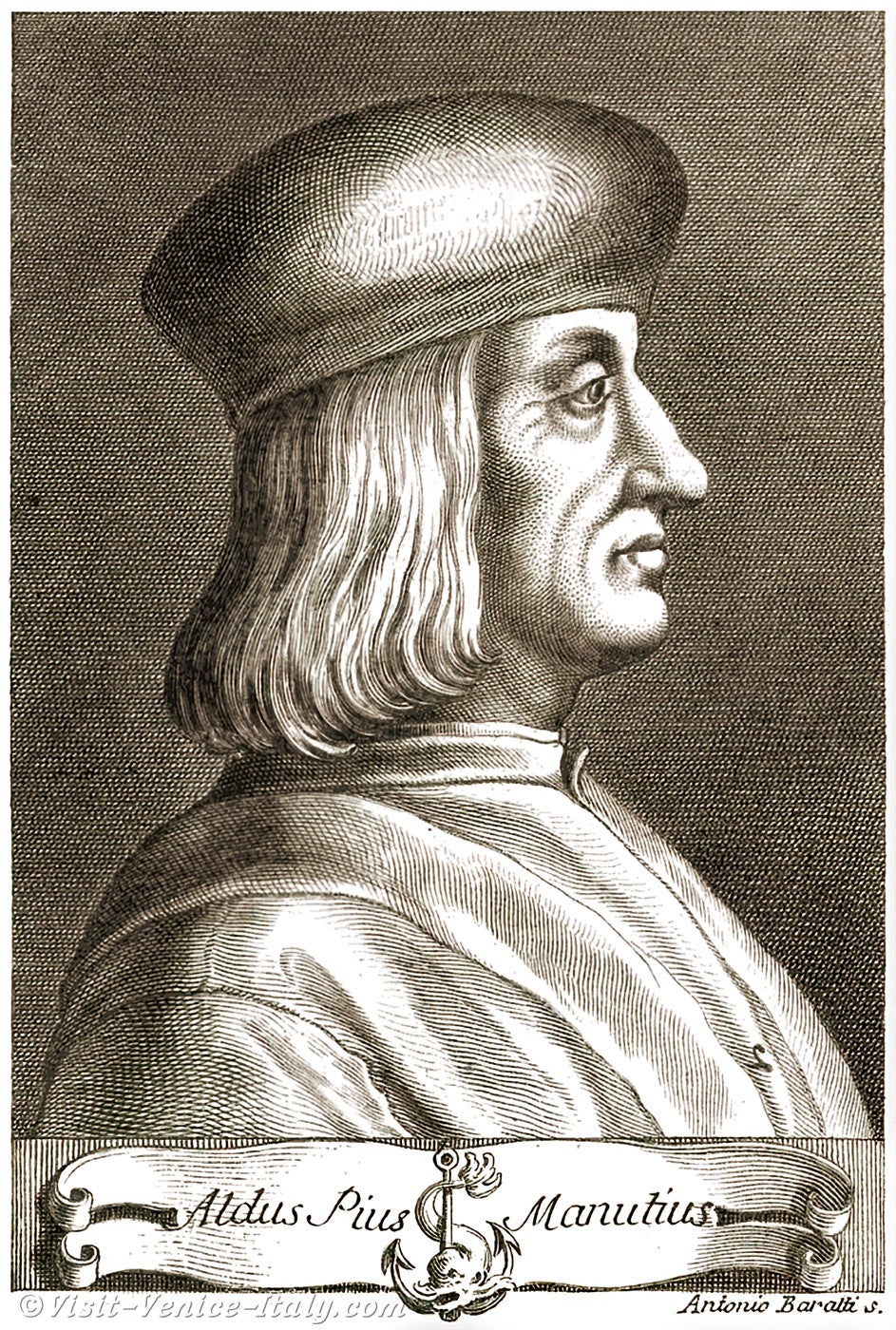
Aldo Manuzio
Venice: Italy’s leading publishing centre.
Result: It cost a third less to publish in Venice than in Rome.To get an idea of the importance of printing in Venice at that time, it is enough to know that the 113 Venetian publishers and printers produced 325 times more books than those in Florence, Milan and Rome combined!
Around 1495–97, of the 1,821 titles recorded as coming off the presses in Europe, 447 came from Venice. Paris, in second place, published only 181!
Why was Venice so far ahead?
Venice offered numerous opportunities for printing and the distribution of books at that time.Venice was, in fact, a hub of trade between the East and the West and thus had buyers throughout Europe.
Furthermore, the paper used to print the books was produced in Italy.
For book production, there were also many skilled workers in Venice.
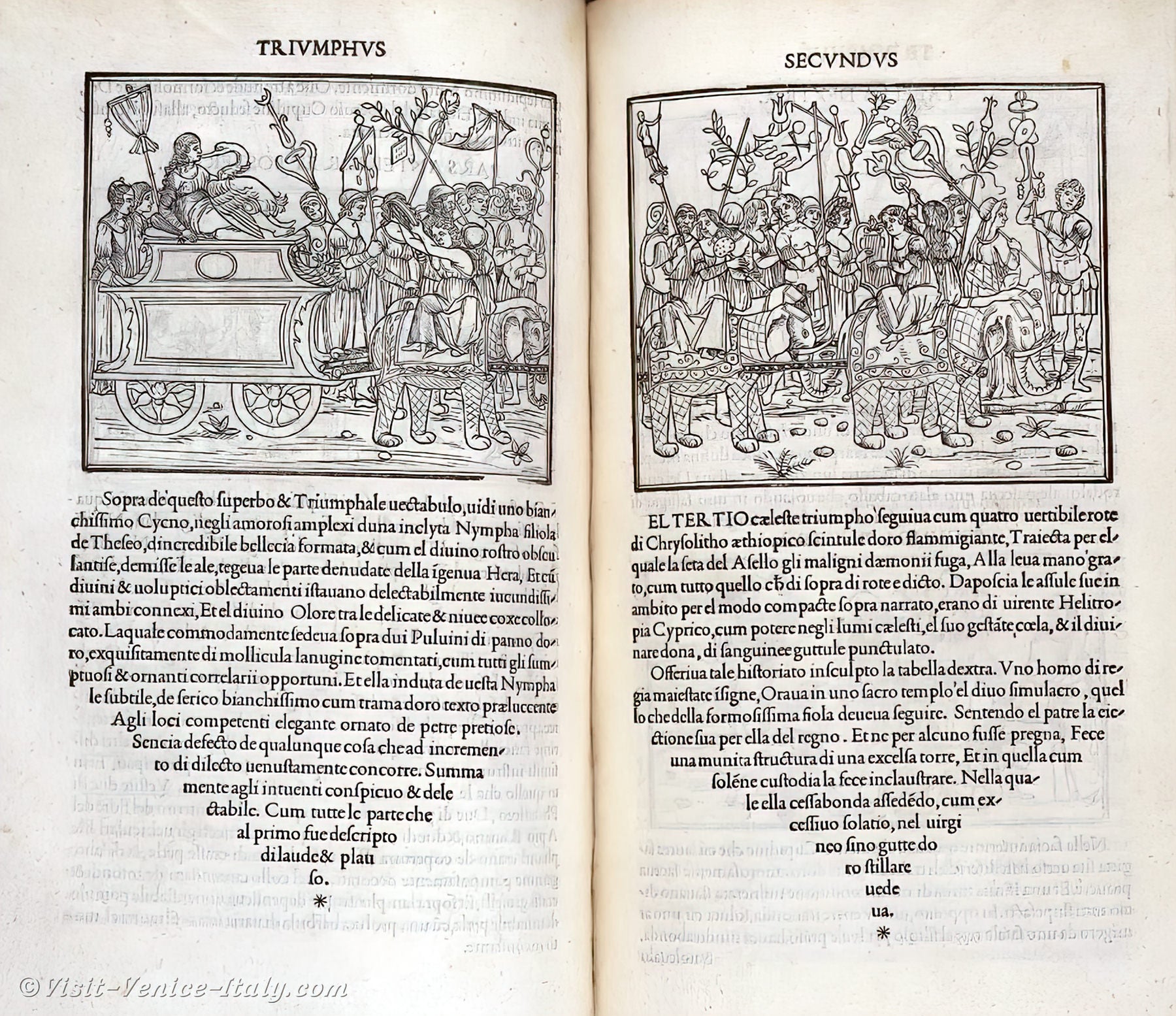
Hypnerotomachia Poliphili But in addition to these material and commercial factors, Venice, at that time, was also a major centre of intellectual life in Europe and boasted a sizeable readership of so-called cultured readers.
Indeed, in addition to native Venetians, many Jewish, Greek and Armenian scholars settled in Venice after 1492 and 1453.
Finally, and this was no minor factor, the Venetian government was more willing to grant printing licences and reproduction rights than in other countries.
It was at the beginning of the 16th century that Venetian printers produced their finest works: at that time, there was competition with the producers of illuminated manuscripts and codices.
Humanists were among the best customers.
1495: Aldo Manuzio founded the Aldine Press.
As a true humanist, Aldo Manuzio (Aldus Manutius) believed that:‘Those who pursue learning must obtain the books necessary for their purpose’; and I shall not rest until their supply is assured.’
With financial backing from Andréa Torresano, he purchased high-quality type punches made by Jensen (a leading specialist who had settled in Venice) and commissioned craftsmen capable of carving Greek type matrices whose design imitated the calligraphy of ancient authors.
Hypnerotomachia Poliphili For Aldo Manuzio’s talent also lies in this: he knows how to surround himself with the best colleagues – often friends – including, amongst the most famous, Erasmus of Rotterdam and even Albrecht Dürer!
Aldo Manuzio invented italics.
This is one of the greatest hallmarks of Aldo Manuzio’s genius. He decided to revolutionise printed type – which, before his time, had been particularly difficult to read – and therefore set about designing a typeface that would resemble handwriting.He named it italic.
It also takes up less space on the page than standard typefaces.
Aldo Manuzio and the invention of the “octavo” and the paperback!
As well as being difficult to read, old books were very large and very heavy, as well as being extremely expensive.Aldo Manuzio then came up with the idea of folding these large sheets of paper into eighths, which resulted in 16 printed pages, which he named ‘octavo’.
A name chosen because the resulting book was eight times smaller!
Quality and efficiency in the book industry.
The Aldine printing works employed more than 30 people full-time in a single location: highly skilled craftsmen, apprentices, labourers and unskilled workers, but also, and above all, scholars to check the proofs such as the great philosopher and scholar Erasmus of Rotterdam, for example.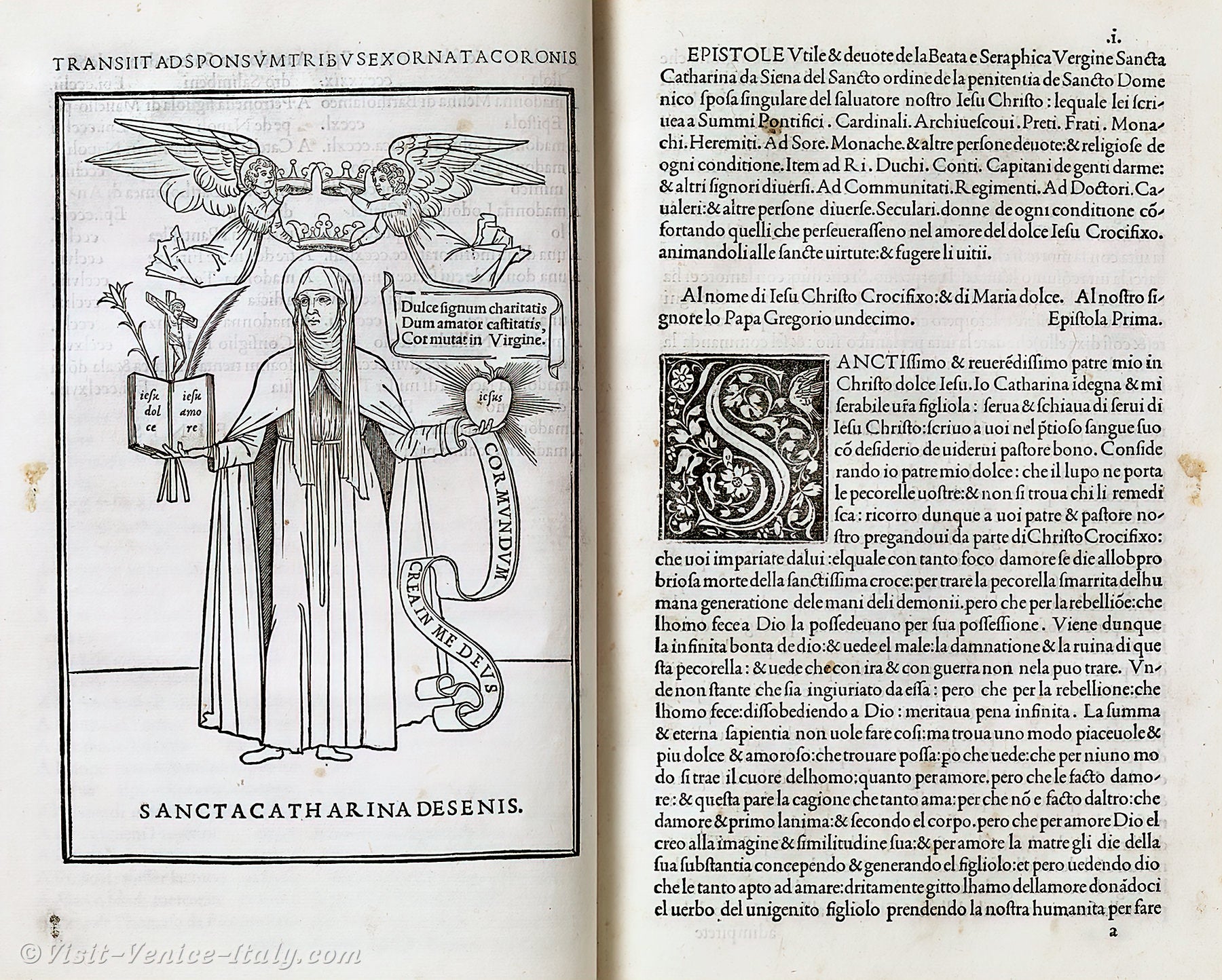
Hypnerotomachia Poliphili Aldo Manuzio was the first person to succeed in reducing the size, weight and cost of books.
This stroke of genius – which seems so natural to us today – made books accessible to a wider market and thus also to readers less well-off than the nobility and other prominent figures of the time.
It was this major advance in printing that also enabled the expansion of the publication of works of entertainment.
Thus, Venice succeeded, thanks to Aldo Manuzio, in attracting authors whose works could therefore sell more readily.
The first author to leave the court of a prince to lead a free life in Venice, where his works could be published not only freely but also at a reduced price, was the famous Aretino.
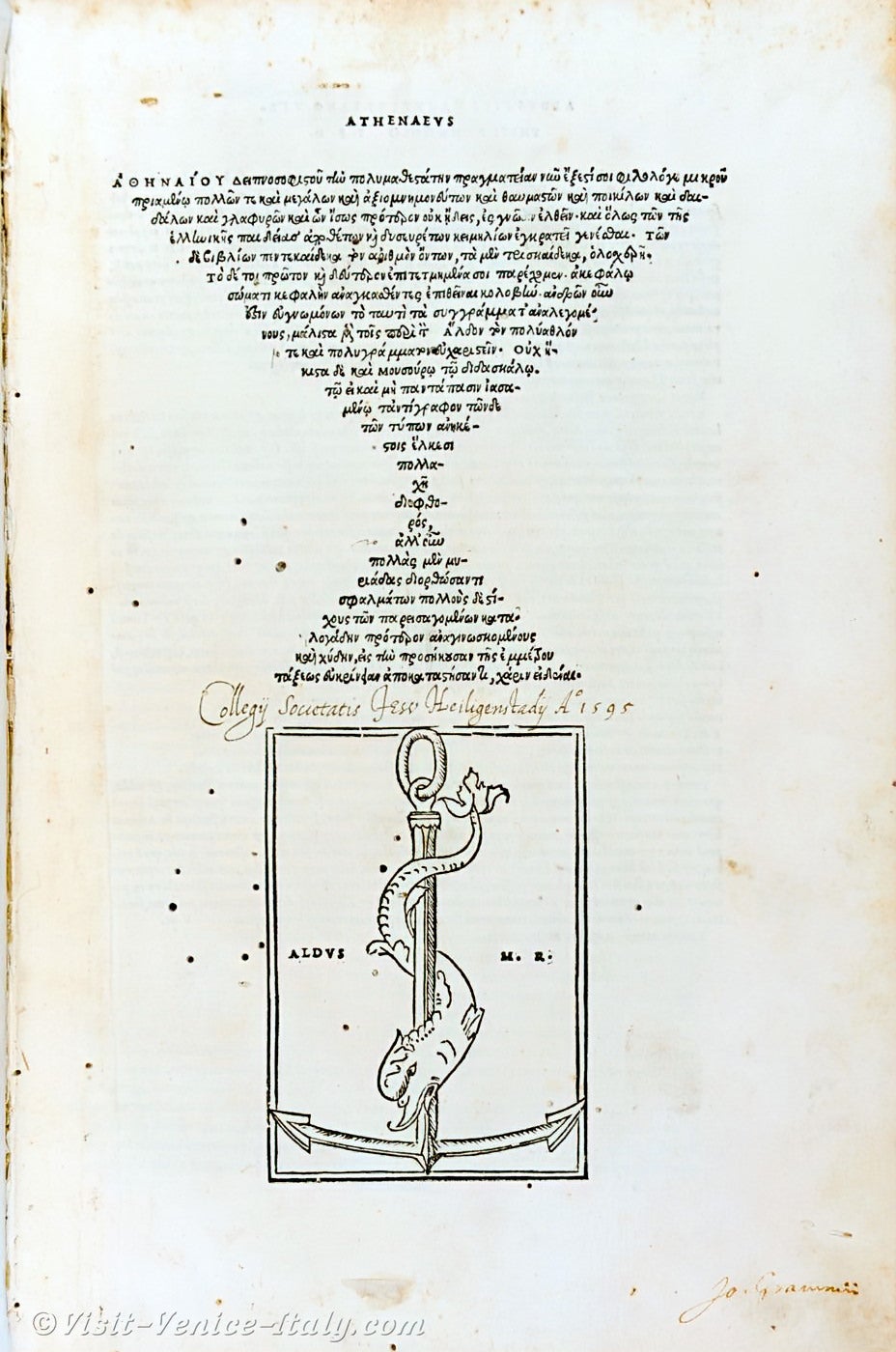
The anchor and the dolphin, ‘Festina Lente’, Aldo Manuzio’s emblem
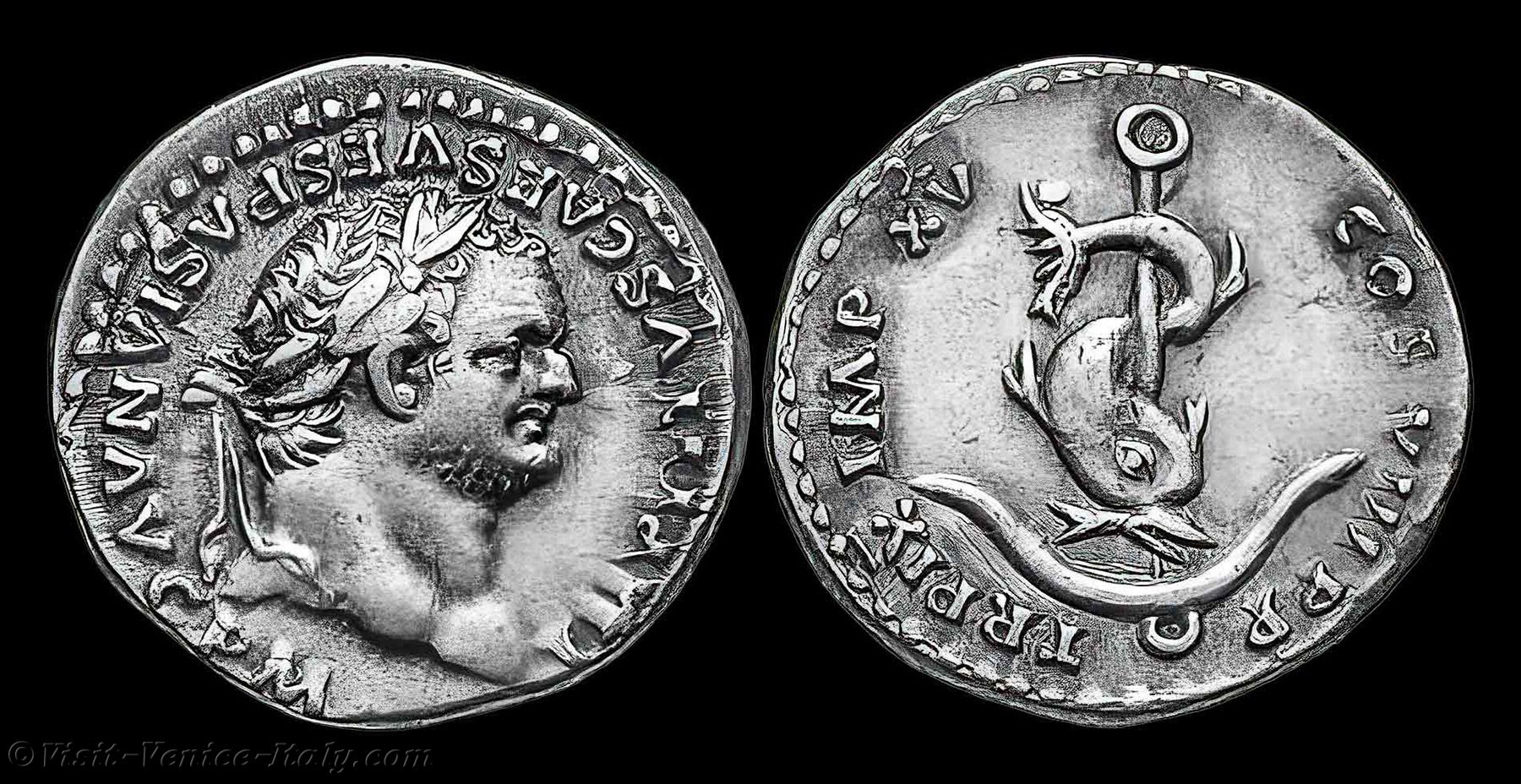
Vespasian coin: The dolphin and the anchor Aldo Manuzio had chosen as his emblem a dolphin coiled around an anchor.
Suetonius states that Emperor Augustus had adopted as his motto a classical Greek proverb, ‘Speude bradeôsi’, or in Latin ‘Festina Lente’ : “Hurry slowly” (or take your time).
After Augustus, the coins of the emperors Vespasian, Domitian and Hadrian also bore on their reverse a dolphin coiled around an anchor.
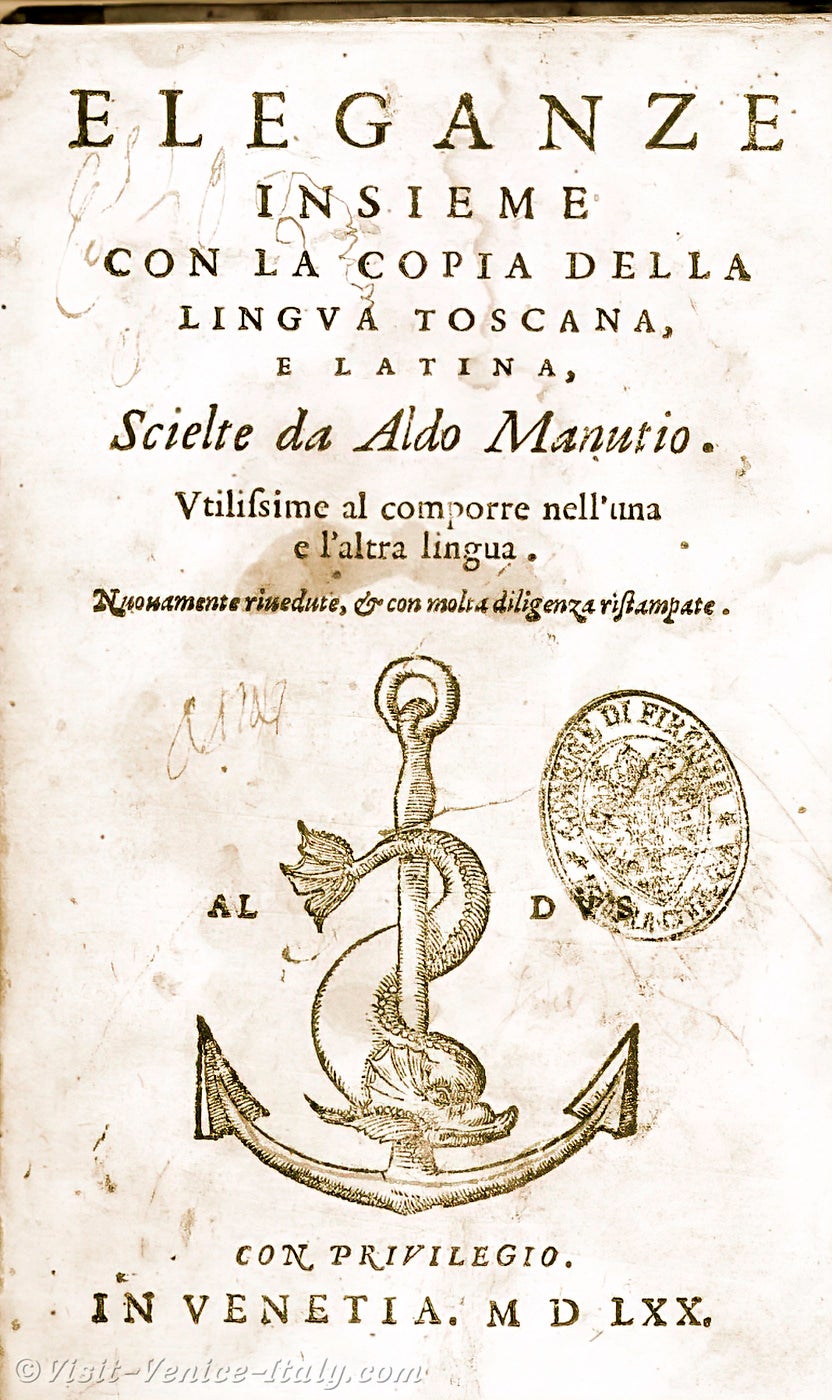
Manuzio’s emblem Following in the footsteps of his illustrious predecessors, Aldo Manuzio also adopted this “Festina Lente” as his own emblem.
Aldo Manuzio’s emblem inspired many printers who followed in his footsteps, including Ambrais Brillard of Bourges in France, who had accompanied his anchor and dolphin with the motto ‘Sic Proprere Cunctandum’, ‘Hurry by delaying’.
The motto was taken up by Jean de la Fontaine in his fable of the hare and the tortoise: “There’s no point in running; you must set off at the right time”.
Manuzio’s message was linked to his trade, which required a great deal of work for each book, work that demanded expertise and concentration and therefore taking the time needed to produce high-quality work.
Nevertheless, the ultimate goal was the printing of the book, and this required consistency and regularity in its preparation : ‘Hurry slowly’
Important dates | Politics | Navy | Love | Wars | Religion | Scuole | Ghetto | Printing
Back to Top of Page